
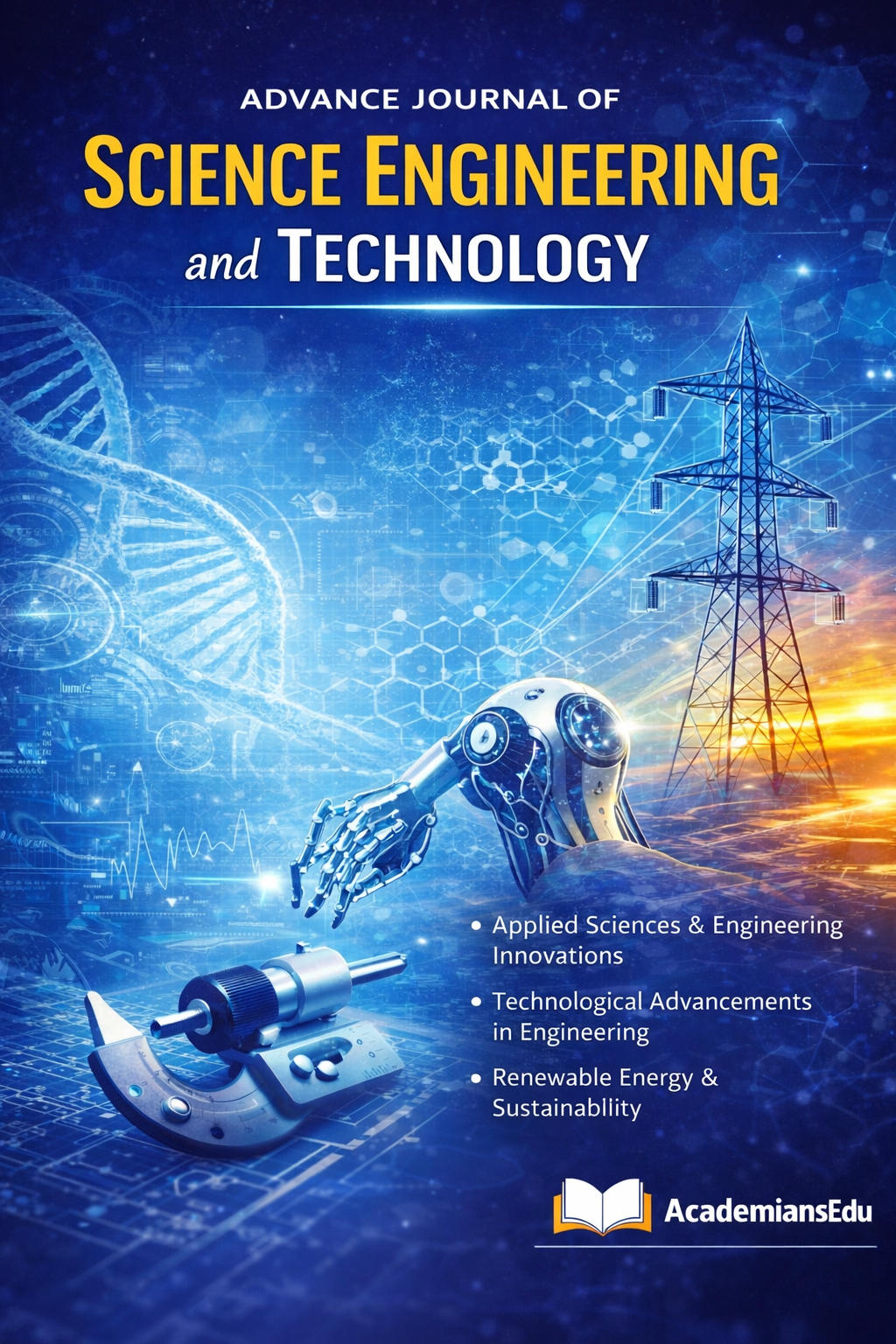
The Advance Journal of Science, Engineering and Technology (AJSET) is an international, peer-reviewed, open-access scholarly journal dedicated to publishing high-quality research that advances knowledge in science, engineering, and technological innovation.
ISSN: 3141-3153
Publication Frequency: Quarterly
All articles published in this journal are freely accessible under an open access policy. Authors retain copyright of their work while granting the journal permission to publish.
Aims and scope
Advance Journal of Science, Engineering and Technology (AJSET) is an international, peer-reviewed, open-access scholarly journal dedicated to publishing high-quality research that advances knowledge in science, engineering, and technological innovation. The journal aims to provide a global platform for researchers, engineers, scientists, and technology professionals to share original research, theoretical developments, and practical applications that contribute to scientific progress and technological advancement.
AJSET encourages multidisciplinary and interdisciplinary research that connects fundamental scientific discoveries with engineering solutions and real-world technological applications. The journal seeks to promote research that addresses modern industrial challenges, sustainable development, technological transformation, and emerging scientific innovations.
The scope of the journal broadly covers research areas across science, engineering, and applied technologies, including but not limited to the following fields:
Natural and Applied Sciences
- Applied Physics and Materials Science
- Chemical Sciences and Industrial Chemistry
- Environmental Science and Environmental Engineering
- Earth Sciences and Atmospheric Science
- Applied Mathematics and Scientific Modeling
- Computational Science and Simulation
Engineering Disciplines
- Mechanical Engineering and Manufacturing Engineering
- Civil and Structural Engineering
- Electrical and Electronic Engineering
- Chemical and Process Engineering
- Industrial and Production Engineering
- Aerospace Engineering and Automotive Engineering
- Mechatronics and Instrumentation Engineering
Technology and Applied Innovations
- Computer Science and Information Technology
- Software Engineering and Systems Engineering
- Robotics and Intelligent Systems
- Internet of Things (IoT) and Smart Systems
- Renewable Energy Technologies and Sustainable Engineering
- Nanotechnology and Advanced Materials
- Engineering Design and Technological Innovation
- Emerging Engineering Technologies and Applied Research
The journal publishes original research articles, review articles, technical papers, short communications, and case studies that contribute to scientific discovery, engineering innovation, and technological advancement.
Interdisciplinary research integrating science, engineering, and applied technology is particularly encouraged.
The Advance Journal of Science, Engineering and Technology aims to support the global exchange of scientific and engineering knowledge and to promote research that contributes to technological development, industrial innovation, and sustainable solutions for modern society.
Related journals
Explore other journals published by Academians Publishers.
Editorial Board Members
Journal Information
This is overview content.
Journal Archive
Author Guidelines
Before You Start
Authors are encouraged to carefully review the journal's Aims and Scope before submitting a manuscript to ensure that the submission aligns with the journal's academic focus and publication objectives.
For questions regarding manuscript preparation or submission, authors may contact the Editorial Office at:
Author Responsibilities
Authors submitting manuscripts to the Advance Journal of Science, Engineering and Technology (AJSET) are expected to:
- Ensure the originality, accuracy, and integrity of the submitted work.
- Confirm that the manuscript has not been published previously and is not under consideration by another journal.
- Ensure that all listed authors have made significant scholarly contributions to the research.
- Properly acknowledge all sources, citations, and contributors.
- Respond promptly to editorial communications and revision requests.
- Disclose any financial or personal conflicts of interest that may influence the research or publication process.
- Be prepared to provide underlying research data if requested during editorial evaluation.
- Promptly notify the journal if a significant error is discovered in a published article.
Research involving laboratory experiments, engineering systems, human participants, animals, environmental assessments, surveys, interviews, or sensitive data must comply with relevant ethical standards and institutional requirements. Where applicable, authors should obtain appropriate ethics approval before conducting the research.
Publication Ethics
The Advance Journal of Science, Engineering and Technology (AJSET) is committed to maintaining the highest standards of publication ethics and research integrity. The journal follows internationally recognized ethical publishing principles and applies its editorial policies in accordance with the guidelines of:
- Committee on Publication Ethics (COPE)
- International Committee of Medical Journal Editors (ICMJE)
All manuscripts may be screened using plagiarism detection software (e.g., iThenticate) before peer review. Manuscripts containing plagiarism, fabricated or falsified data, duplicate publication, manipulated images, unethical research practices, or other forms of research misconduct may be rejected or withdrawn in accordance with the publisher's ethical policies.
Data Availability Statement
Authors are required to include a Data Availability Statement in their manuscript where applicable. The statement should indicate where supporting research data can be accessed, including recognized repositories such as Zenodo, Figshare, Dryad, GenBank, institutional repositories, or other appropriate data archives. If data cannot be shared because of ethical, legal, privacy, confidentiality, or commercial restrictions, authors should clearly explain the reason within the manuscript.
Policy on Artificial Intelligence (AI) Tools
Authors may use generative AI tools for language improvement, grammar assistance, or editorial support. However, authors remain fully responsible for the originality, accuracy, integrity, and scientific validity of the submitted work.
- AI tools cannot be listed as authors.
- Any significant use of generative AI must be disclosed in the Acknowledgements or Methods section of the manuscript.
- Authors remain fully responsible for verifying all AI-assisted content.
- AI-generated material must not contain plagiarism, fabricated information, or inaccurate citations.
Manuscript Preparation
File Format
- Manuscripts must be submitted in Microsoft Word (.doc or .docx) format.
- Manuscripts should be written in clear academic English.
- Use Times New Roman, font size 12, with appropriate spacing and margins.
Article Types
The journal welcomes submissions in the following categories: Original Research Articles, Review Articles, Short Communications, Case Studies, and Technical Reports.
Article Length
The recommended manuscript length varies according to article type. Authors should prepare manuscripts that present the research clearly and concisely.
Manuscript Structure
Where applicable, manuscripts should contain the following sections:
- Title
- Author Names and Affiliations
- Abstract
- Keywords
- Introduction
- Literature Review (where applicable)
- Materials and Methods / Methodology
- Results
- Discussion
- Conclusion
- Acknowledgements (optional)
- Data Availability Statement (where applicable)
- Conflict of Interest Statement
- References
Abstract and Keywords: All manuscripts must include an abstract of no more than 250 words. Authors should provide 3–8 keywords representing the principal topics of the manuscript.
Figures and Tables: Figures and tables should be numbered consecutively. Images should be high quality (JPEG/PNG). Tables should be editable.
Submission Process
Manuscripts must be submitted through the journal's official online submission system. Before submission, authors should ensure that all required files and information have been provided. The submission should include: Manuscript (Word format), Author information, Cover letter (where applicable), and Ethics approval statement (where applicable).
Peer Review Process
All submitted manuscripts undergo a double-blind peer review process. Following an initial editorial screening, manuscripts that satisfy the journal's basic editorial requirements are evaluated by at least two independent expert reviewers based on originality, scientific quality, methodological rigor, clarity, ethical compliance, technical contribution, and relevance to the journal's scope.
Editorial decisions may include: Accept, Minor Revision, Major Revision, Reject. The peer review process generally takes between 6 and 12 weeks.
Article Processing Charge (APC)
The Advance Journal of Science, Engineering and Technology (AJSET) applies an Article Processing Charge (APC) of USD 50 for accepted manuscripts. No submission fee is charged. The APC becomes payable only after a manuscript has been formally accepted for publication.
The APC supports: Editorial management, Double-blind peer review coordination, Professional copyediting and typesetting, DOI registration, Online publication and hosting, and Long-term digital archiving and preservation. Payment of the APC does not influence editorial decisions, peer review outcomes, or the acceptance of any manuscript.
Contact Information
For questions regarding manuscript preparation, submission, or publication policies, please contact:
Email: editorial@academiansedu.org
Editorial Team
Editorial board members.
Editor-in-Chief
Prof. Dr. Syed Zafar Ilyas
Dean Sciences / Chairman / Professor
Department of Physics
Allama Iqbal Open University
Sector H-8, Islamabad-44000, Pakistan
Editorial Board Members
Prof. Othman Y. Alothman
Editorial Board Member
King Saud University, Saudi Arabia
Email: othman@ksu.edu.sa
Prof. Nadir Ayrilmis
Editorial Board Member
Istanbul Üniversitesi, Istanbul, Turkey
Email: nadiray@istanbul.edu.tr
Prof. Mohammad Lotfy Hassan
Editorial Board Member
National Research Centre, Cairo, Egypt
Email: mlhassan2012@yahoo.com
Dr. Mohamed Yagoub
Editorial Board Member
University of Biskra, Algeria
Dr. Mahdi Abdeddaim
Editorial Board Member
University of Biskra, Algeria
Email: m.abdeddaim@univ-biskra.dz
Indexing & Abstracting
Google Scholar
Indexed
Zenodo
DOI Registration
Academia.edu
Academic Network
Future Indexing
DOAJ / Scopus / Web of Science
Reviewer Information
Peer Review Process
AcademiansEdu journals operate a rigorous double-blind peer review system to ensure fairness, objectivity, and academic integrity. In this process, the identities of both authors and reviewers remain confidential throughout the review process.
Following an initial editorial screening, manuscripts that meet the journal's basic editorial requirements are assigned to at least two independent expert reviewers with appropriate subject expertise and academic experience.
Reviewers evaluate manuscripts based on:
- Originality and contribution to the field
- Scientific quality and methodological rigor
- Relevance to the journal's scope
- Ethical compliance and research integrity
- Clarity of presentation and organization
- Validity of results and conclusions
- Adequacy and relevance of references
Constructive reviewer feedback plays a vital role in improving manuscript quality and supporting informed editorial decisions. Reviewer assignments and reports are managed through the journal's editorial system to ensure transparency, consistency, and confidentiality.
Mission
The mission of the peer review process at AcademiansEdu is to uphold excellence in scholarly publishing by ensuring that all published research meets the highest standards of scientific quality, originality, ethical integrity, and academic rigor.
Vision
Our vision is to develop a diverse global network of qualified reviewers who contribute their expertise to promote transparent, objective, reliable, and impactful scholarly communication across all disciplines served by AcademiansEdu.
Values
AcademiansEdu values academic integrity, fairness, diversity, professionalism, and constructive collaboration. Our reviewers represent an international community of researchers and professionals who provide objective, respectful, confidential, and evidence-based evaluations that help maintain the quality and credibility of published research.
Reviewer Responsibilities and Ethics
Reviewers play an essential role in maintaining the integrity of the scholarly publication process. By accepting a review invitation, reviewers agree to uphold the following responsibilities:
- Treat all submitted manuscripts and related materials as strictly confidential.
- Do not share, distribute, or discuss manuscripts with anyone outside the editorial process without prior permission from the editorial office.
- Provide objective, constructive, and evidence-based evaluations supported by clear scientific reasoning.
- Complete reviews within the requested review period or promptly notify the editorial office if unable to do so.
- Identify relevant published work that has not been appropriately cited where applicable.
- Disclose any financial, professional, institutional, or personal conflicts of interest and decline review assignments where impartiality may be compromised.
- Evaluate manuscripts solely on their academic merit without discrimination based on nationality, gender, institutional affiliation, ethnicity, religion, political beliefs, or other personal characteristics.
- Report any suspected plagiarism, duplicate publication, fabricated data, image manipulation, unethical research practices, or other forms of research misconduct to the editorial office.
Use of Generative AI by Reviewers
To protect the confidentiality and integrity of the peer review process, reviewers must not use generative artificial intelligence (AI) tools to generate or substantially write peer review reports.
Reviewers remain fully responsible for the content, accuracy, confidentiality, and professional judgment expressed in their reviews. The use of AI tools that could compromise manuscript confidentiality or produce inaccurate or misleading evaluations is not permitted.
News
Call for Papers 2025 – Journal of Arts, Humanities and Society
The editorial board of the Journal of Arts, Humanities and Society invites researchers, scholars, and practitioners to submit original manuscripts for publication in the upcoming 2025 issues. We welcome high-quality research articles, review papers, and interdisciplinary studies related to arts, humanities, and social sciences.
Call for Papers 2025 – African Journal of Business, Economics and Management
The African Journal of Business, Economics and Management invites submissions for the 2025 publication cycle. Authors are encouraged to submit innovative research covering areas such as economics, business strategy, finance, marketing, entrepreneurship, and organizational management.