
Journal of Environmental and Sustainability Science
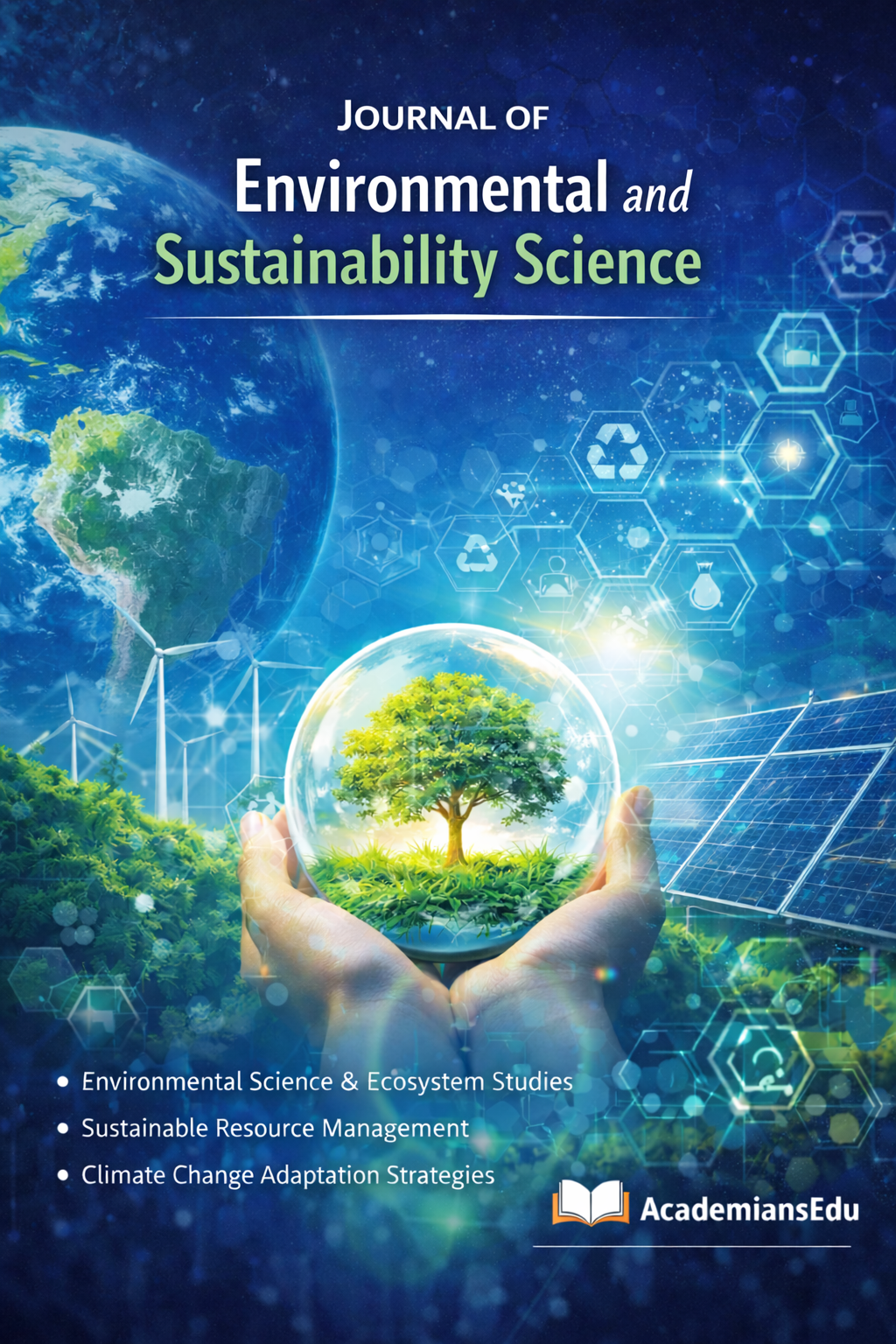
The Journal of Environmental and Sustainability Science (IJESS) is an international, peer-reviewed, open-access scholarly journal dedicated to publishing high-quality research focused on environmental systems, sustainable development, and ecological sustainability.
ISSN: 3141-3684
Publication Frequency: Quarterly
All articles published in this journal are freely accessible under an open access policy. Authors retain copyright of their work while granting the journal permission to publish.
Aims and Scope
The Journal of Environmental and Sustainability Science (IJESS) is an international, peer-reviewed, open-access scholarly journal dedicated to publishing research on agricultural environments, sustainable resource management, and applied ecological practices. The journal provides a global platform for researchers, environmental scientists, and agricultural specialists to present innovative strategies addressing soil, water, and crop sustainability challenges.
IJESS focuses on practical, scientific approaches to managing natural resources and mitigating environmental degradation. The journal welcomes original research articles, review papers, and technical case studies across the following focused domains:
- Agricultural & Agro-Ecosystem Sustainability: Sustainable farming systems, crop stress management, horticultural sustainability, soil quality management, and agricultural plant physiology.
- Water & Land Resource Management: Irrigation management, agricultural hydrology, soil and water conservation, land-use sustainability, and watershed management.
- Environmental Chemistry & Pollution Control: Soil and water chemistry, environmental monitoring, agricultural chemical management, and eco-friendly chemical processes.
- Environmental Systems & Risk Assessment: Environmental impact analysis, risk assessment of ecosystems, natural resource conservation, and applied sustainability metrics.
The journal welcomes original research articles, review articles, policy analyses, case studies, and short communications that contribute to the advancement of environmental science and sustainable development practices.
Interdisciplinary research integrating environmental systems, sustainability science, technology, and policy frameworks is particularly encouraged.
The Journal of Environmental and Sustainability Science aims to support the global dissemination of knowledge that promotes environmental protection, sustainable resource management, and innovative solutions for addressing the environmental challenges facing modern society.
Featured articles
[featured_articles]Editorial Board Members

This is overview content.
Journal Archive
Volume 1, Issue 4
December 2026The contents of this issue will be available once the issue is officially released. View Issue
Author Guidelines
Before You Start
Authors are encouraged to carefully review the journal's Aims and Scope before submitting a manuscript to ensure that the submission aligns with the journal's academic focus and publication objectives.
For questions regarding manuscript preparation or submission, authors may contact the Editorial Office at:
Author Responsibilities
Authors submitting manuscripts to the Journal of Environmental and Sustainability Science (IJESS) are expected to:
- Ensure the originality, accuracy, and integrity of the submitted work.
- Confirm that the manuscript has not been published previously and is not under consideration by another journal.
- Ensure that all listed authors have made significant scholarly contributions to the research.
- Properly acknowledge all sources, citations, and contributors.
- Respond promptly to editorial communications and revision requests.
- Disclose any financial or personal conflicts of interest that may influence the research or publication process.
- Be prepared to provide underlying research data if requested during editorial evaluation.
- Promptly notify the journal if a significant error is discovered in a published article.
Research involving environmental fieldwork, ecological systems, human participants, biological materials, surveys, interviews, or sensitive data must comply with relevant ethical standards and institutional requirements. Where applicable, authors should obtain appropriate ethics approval before conducting the research.
Publication Ethics
The Journal of Environmental and Sustainability Science (IJESS) is committed to maintaining the highest standards of publication ethics and research integrity. The journal follows internationally recognized ethical publishing principles and applies its editorial policies in accordance with the guidelines of:
- Committee on Publication Ethics (COPE)
- International Committee of Medical Journal Editors (ICMJE)
All manuscripts may be screened using plagiarism detection software (e.g., iThenticate) before peer review. Manuscripts containing plagiarism, fabricated or falsified data, duplicate publication, manipulated images, unethical research practices, or other forms of research misconduct may be rejected or withdrawn in accordance with the publisher's ethical policies.
Data Availability Statement
Authors are required to include a Data Availability Statement in their manuscript where applicable. The statement should indicate where supporting research data can be accessed, including recognized repositories such as Zenodo, Figshare, Dryad, GenBank, institutional repositories, or other appropriate data archives. If data cannot be shared because of ethical, legal, privacy, confidentiality, or commercial restrictions, authors should clearly explain the reason within the manuscript.
Policy on Artificial Intelligence (AI) Tools
Authors may use generative AI tools for language improvement, grammar assistance, or editorial support. However, authors remain fully responsible for the originality, accuracy, integrity, and scientific validity of the submitted work.
- AI tools cannot be listed as authors.
- Any significant use of generative AI must be disclosed in the Acknowledgements or Methods section of the manuscript.
- Authors remain fully responsible for verifying all AI-assisted content.
- AI-generated material must not contain plagiarism, fabricated information, or inaccurate citations.
Manuscript Preparation
File Format
- Manuscripts must be submitted in Microsoft Word (.doc or .docx) format.
- Manuscripts should be written in clear academic English.
- Use Times New Roman, font size 12, with appropriate spacing and margins.
Article Types
The journal welcomes submissions in the following categories: Original Research Articles, Review Articles, Short Communications, Case Studies, Environmental Assessment Reports, and Policy Analyses.
Article Length
The recommended manuscript length varies according to article type. Authors should prepare manuscripts that present the research clearly and concisely.
Manuscript Structure
Where applicable, manuscripts should contain the following sections:
- Title
- Author Names and Affiliations
- Abstract
- Keywords
- Introduction
- Literature Review (where applicable)
- Materials and Methods / Methodology
- Results
- Discussion
- Conclusion
- Acknowledgements (optional)
- Data Availability Statement (where applicable)
- Conflict of Interest Statement
- References
Abstract and Keywords: All manuscripts must include an abstract of no more than 250 words. Authors should provide 3–8 keywords representing the principal topics of the manuscript.
Figures and Tables: Figures and tables should be numbered consecutively. Images should be high quality (JPEG/PNG). Tables should be editable.
Supplementary Materials: Authors may submit supplementary materials such as datasets, environmental monitoring data, GIS files, software code, multimedia files, appendices, additional figures, or other supporting documents relevant to the study.
References: References should follow the citation style specified by the journal. Authors are encouraged to consult the journal's manuscript template and formatting instructions before submission.
Submission Process
Manuscripts must be submitted through the journal's official online submission system. Before submission, authors should ensure that all required files and information have been provided. The submission should include: Manuscript (Microsoft Word format), Author information, Cover letter (where applicable), and Ethics approval statement (where applicable).
Peer Review Process
All submitted manuscripts undergo a double-blind peer review process. Following an initial editorial screening, manuscripts that satisfy the journal's basic editorial requirements are evaluated by at least two independent expert reviewers based on originality, scientific quality, methodological rigor, clarity, ethical compliance, and relevance to the journal's scope.
Editorial decisions may include: Accept, Minor Revision, Major Revision, Reject. The peer review process generally takes between 6 and 12 weeks, depending on reviewer availability, manuscript complexity, and the extent of revisions required.
Open Access Policy & Article Processing Charge (APC)
The Journal of Environmental and Sustainability Science (IJESS) operates under the Gold Open Access publishing model. All published articles are immediately and permanently available free of charge under the Creative Commons Attribution 4.0 International License (CC BY 4.0).
The Journal of Environmental and Sustainability Science (IJESS) applies an Article Processing Charge (APC) of USD 50 for accepted manuscripts. No submission fee is charged. The APC becomes payable only after a manuscript has been formally accepted for publication.
The APC supports: Editorial management, Double-blind peer review coordination, Professional copyediting and typesetting, DOI registration, Online publication and hosting, and Long-term digital archiving and preservation. Payment of the APC does not influence editorial decisions, peer review outcomes, or the acceptance of any manuscript.
Copyright and Licensing
Authors retain full copyright of their published work. Articles are published under the Creative Commons Attribution 4.0 International License (CC BY 4.0), allowing unrestricted sharing, adaptation, distribution, and reproduction in any medium, including commercial use, provided appropriate credit is given to the original author(s) and source.
Contact Information
For questions regarding manuscript preparation, submission, or publication policies, please contact:
Email: editorial@academiansedu.org
Editorial Team
Editorial board members.
Chief Editor
Tabarak Abdullah Alwan
Chief Editor
Department of Environmental Sciences, College of Energy and Environmental Sciences
Al-Kharkh University of Science
Email: tabark.k.abdulla@kus.edu.iq
Associate Editors
Dr. Daniele De Wrachien
Associate Editor
Retired Professor,
Department of Agricultural and Environmental Sciences
The State University of Milan, Italy
Email: daniele.dewrachien@unimi.it
Prof. Oğuz Dolgun
Associate Editor
Head of Horticulture Department
Sultanhisar Vocational School
Aydin Adnan Menderes University, Turkey
Email: oguzdolgun@adu.edu.tr
Dr. Subodh Kumar Maiti
Associate Editor / Professor
Department of Environmental Science and Engineering, Indian Institute of Technology (ISM) Dhanbad, Jharkhand, India
Email: subodh@iitism.ac.in
Dr. Abdel-Ghani Al-Menaie
Associate Editor / Senior Research Scientist
Environment and Life Sciences Research Center (ELSRC), Kuwait Institute for Scientific Research (KISR), Safat, Kuwait
Email: gmenaie@kisr.edu.kw
Prof. Saad Farouk Mohamed Hussiien Gadalla
Associate Editor
Department of Agricultural Botany
Faculty of Agriculture
Mansoura University, Egypt
Email: saadfarouk@mans.edu.eg
Dr. Olalekan S. Fatoki
Associate Editor / Professor
Department of Chemistry, Faculty of Applied Sciences, Cape Peninsula University of Technology (CPUT), Cape Town, South Africa
Email: fatokio@cput.ac.za
Dr. Bing-Lan Liu
Associate Editor
Department of Applied Chemistry
Chaoyang University of Technology
Taichung, Taiwan
Email: blliu@cyut.edu.tw
Prof. Dr. Frederick Ato Armah
Associate Editor
Professor of Environmental and Sustainability Science
Directorate of Research, Innovation and Consultancy (DRIC) / Department of Environmental Science
University of Cape Coast, Ghana.
Email: farmah@ucc.edu.gh
Indexing & Abstracting
Google Scholar
Indexed
Zenodo
DOI Registration
Academia.edu
Academic Network
DOAJ
Indexed
Future Indexing
Scopus / Web of Science
Reviewer Information
Peer Review Process
The Journal of Environmental and Sustainability Science (IJESS) follows a rigorous double-blind peer review process to ensure fairness, objectivity, and academic integrity. In this model, the identities of both authors and reviewers remain confidential throughout the editorial process.
Following an initial editorial screening, each manuscript that meets the journal's basic editorial requirements is assigned to at least two independent expert reviewers with relevant subject expertise. Reviewers evaluate manuscripts based on:
- Originality and contribution to the field
- Scientific and methodological rigor
- Relevance to the journal's scope
- Clarity, organization, and quality of presentation
- Validity of results and conclusions
- Ethical compliance and research integrity
- Adequacy and relevance of references
Constructive reviewer feedback plays an essential role in improving manuscript quality and supporting fair editorial decision-making.
Reviewer Responsibilities
Reviewers are expected to:
- Provide objective, constructive, and evidence-based evaluations.
- Complete reviews within the requested review period whenever possible.
- Maintain strict confidentiality of all submitted manuscripts and associated materials.
- Identify relevant published work that has not been appropriately cited.
- Report any concerns regarding plagiarism, duplicate publication, image manipulation, data fabrication, ethical misconduct, or other research integrity issues.
- Inform the editorial office immediately if they identify any conflict of interest that could affect their impartiality.
- Decline review invitations when they are unable to provide an unbiased or timely review.
Confidentiality
All manuscripts received for review are confidential documents. Reviewers must not share, distribute, reproduce, or discuss any manuscript or its contents with third parties without prior permission from the Editorial Office.
Information obtained during the peer review process must not be used for personal research, commercial purposes, or any other advantage before publication.
Conflict of Interest
Reviewers should disclose any financial, institutional, professional, or personal relationships that could influence their judgment. If a conflict of interest exists, reviewers should decline the invitation to review and notify the Editorial Office promptly.
Use of Generative AI
To protect the confidentiality and integrity of the peer review process, reviewers must not use generative artificial intelligence (AI) tools to generate or substantially write peer review reports.
Reviewers remain fully responsible for the content, accuracy, confidentiality, and professional judgment expressed in their reviews. The use of AI tools that could compromise manuscript confidentiality or produce inaccurate or misleading evaluations is not permitted.
Mission
Our peer review process is dedicated to maintaining excellence in scholarly publishing by ensuring that every published article meets high standards of scientific quality, ethical integrity, methodological rigor, and academic significance.
Vision
We aim to build a diverse international community of expert reviewers who contribute their knowledge and experience to promote transparent, rigorous, and trustworthy scholarly communication.
Core Values
The journal is committed to the following principles:
- Academic integrity
- Fairness and impartiality
- Confidentiality
- Transparency
- Professionalism
- Respectful and constructive communication
- Excellence in scholarly publishing
Recognition of Reviewers
The journal sincerely appreciates the valuable contributions of its reviewers. Reviewer recommendations assist editors in making informed editorial decisions and help authors improve the quality, clarity, and impact of their research.
News
Call for Papers 2025 – Journal of Arts, Humanities and Society
The editorial board of the Journal of Arts, Humanities and Society invites researchers, scholars, and practitioners to submit original manuscripts for publication in the upcoming 2025 issues. We welcome high-quality research articles, review papers, and interdisciplinary studies related to arts, humanities, and social sciences.
Call for Papers 2025 – African Journal of Business, Economics and Management
The African Journal of Business, Economics and Management invites submissions for the 2025 publication cycle. Authors are encouraged to submit innovative research covering areas such as economics, business strategy, finance, marketing, entrepreneurship, and organizational management.